Capacity and reach
Links prepared for video, data and future growth.

High capacity
Fiber optics carry large amounts of data over long distances with low attenuation and immunity to electromagnetic interference. They are suitable for backbones, plants, campuses, cameras and interbuilding connections.
An optical installation requires route engineering, fiber type selection, connectors, spare capacity, splicing and testing. Without documentation and certification, a network may work today but be difficult to maintain or expand.
Coverage in Argentina: TECA designs and integrates projects for businesses, industries, institutions and distributed operations in Buenos Aires and other regions of Argentina.
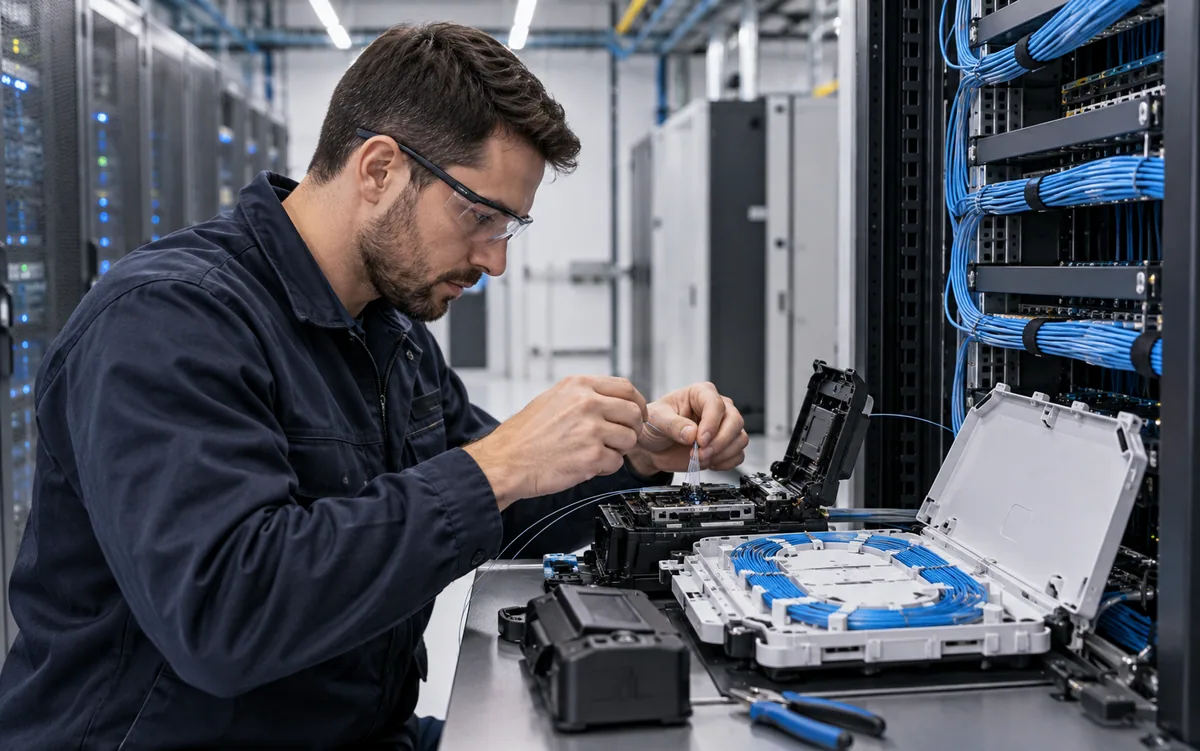
Links prepared for video, data and future growth.
Suitable for industrial environments and interbuilding distances.
Power and OTDR measurements to document losses, splices and continuity.
Important limitation: Final speed also depends on transceivers, active equipment, network design and connector cleanliness. Installing fiber alone cannot fix a congested architecture.
It depends on distance, equipment, growth and budget. The link is designed for its expected service life.
It means measuring losses and events along the link to verify it meets the optical budget and documenting its condition.
Yes. Fiber is widely used for video surveillance backbones and large sites, combined with switches and local power supplies.
Services may include cable installation, splicing, testing, labeling and link documentation.
Tell us about your facility, the issue and your expected outcome. TECA can assess existing infrastructure and propose a phased implementation.